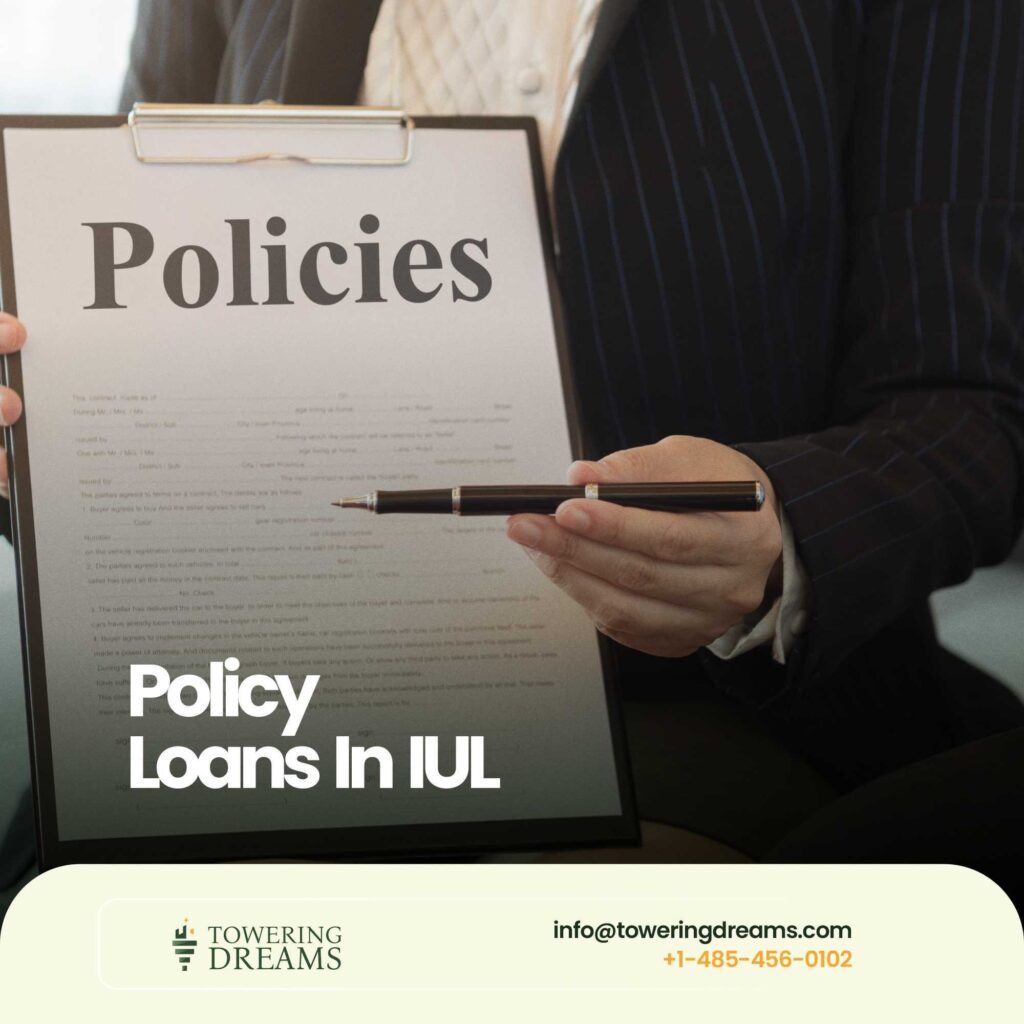
One of the most powerful features of Indexed Universal Life (IUL) insurance is the ability to borrow against your cash value through policy loans. This isn’t like applying for a bank loan with credit checks and approval processes—it’s accessing your own money that’s accumulated in your policy over time.
Policy loans offer remarkable flexibility. Need money for a business opportunity? Take a loan. Want to supplement retirement income? Borrow from your policy. Facing an emergency? Your cash value is there. And here’s the compelling part: when structured properly, policy loans aren’t taxable events, you don’t need to qualify or apply, and the money is available relatively quickly.
But policy loans also come with nuances, risks, and considerations that many people don’t fully understand until problems arise. Interest charges, potential policy lapse, impact on death benefits, and tax consequences if not managed properly can create serious issues. Understanding how policy loans actually work—not just the benefits but also the mechanics and risks—is crucial for using them effectively.
Whether you’re considering purchasing an IUL specifically for the loan feature or you already own a policy and wonder how to access cash value, this guide explains everything you need to know about policy loans in IUL insurance.
Summary
Policy loans in IUL allow policyholders to borrow against accumulated cash value without traditional loan applications, credit checks, or rigid repayment schedules. Loans typically aren’t taxable events if the policy remains in force, making them attractive for tax-free income access, especially in retirement. The insurance company uses your cash value as collateral and charges interest, though many policies credit interest back to your account or continue crediting index returns on borrowed amounts. Loan amounts are limited to a percentage of cash value (typically 90-95%), and outstanding loans plus interest reduce death benefits paid to beneficiaries. Benefits include tax-free access, no qualification requirements, flexible repayment, and use for any purpose. Risks include policy lapse if loans exceed cash value, taxable “phantom income” upon lapse, reduced death benefits, and compounding interest if not managed. Effective loan management requires monitoring loan-to-value ratios, understanding interest mechanics, maintaining adequate cash value, and having clear repayment strategies or acceptance of reduced death benefits.
How Policy Loans Work

Understanding the mechanics of policy loans helps you see how they differ from traditional borrowing and why they offer unique advantages.
The collateral arrangement: When you take a policy loan, you’re not actually withdrawing your cash value. Instead, the insurance company loans you money using your cash value as collateral.
Your cash value remains in the policy, often continuing to earn index credits, while you receive loan proceeds. This is fundamentally different from a withdrawal, which permanently removes cash value.
No qualification required: Unlike bank loans, you don’t apply for policy loans, submit financial information, or undergo credit checks. If you have sufficient cash value, you can borrow against it. Your credit score, income, employment status, and debt levels are irrelevant. The loan is guaranteed by your policy’s cash value.
Accessing the money: You typically request a loan through your insurance company’s website, by phone, or through your agent. Processing takes a few days to two weeks, with funds delivered via check or direct deposit. Some companies offer fast access for smaller amounts.
Loan limits: Most companies allow borrowing up to 90-95% of your cash value. If you have $100,000 in cash value, you can typically borrow $90,000-$95,000. The limitation prevents loans from immediately exceeding cash value when interest accrues.
No required repayment schedule: You’re not required to make payments. You can repay the loan in full, make partial payments, pay only interest, or make no payments at all. The flexibility is extraordinary compared to traditional loans with fixed payment schedules.
Interest charges: The insurance company charges interest on the loan, typically 4-8% depending on the policy and current interest rate environment. This interest accrues and is added to the loan balance if not paid.
Continued growth potential: In many IUL policies, your full cash value continues earning index credits even on the portion securing the loan. Some policies use “direct recognition” where borrowed amounts earn reduced returns, while “non-direct recognition” policies credit the full cash value regardless of loans. This difference significantly affects long-term policy performance with loans.
Impact on death benefit: Outstanding loan balances plus accrued interest are deducted from the death benefit when you die. If you have a $500,000 death benefit and $100,000 in loans, your beneficiaries receive $400,000.
Tax Advantages of Policy Loans

The tax treatment of policy loans is a primary reason many people use IUL for cash value accumulation and retirement income.
Not taxable events: Policy loans generally aren’t considered taxable income as long as your policy remains in force. You’re borrowing money using your asset as collateral, not receiving income. This is similar to a home equity loan—you’re not taxed on the loan proceeds.
Tax-free retirement income: Many people use policy loans as tax-free retirement income supplements. Instead of withdrawing from taxable retirement accounts, they borrow from IUL policies, receiving income without increasing taxable income. This strategy avoids pushing you into higher tax brackets, prevents Social Security benefit taxation increases, and keeps Medicare premiums lower.
No impact on other benefits: Because policy loans aren’t taxable income, they don’t affect income-based government benefits like Social Security, Medicare, Medicaid, or subsidies for health insurance premiums. For retirees managing income to preserve benefits, this is enormously valuable.
Growth remains tax-deferred: Even while loans are outstanding, your remaining cash value grows tax-deferred. You’re not triggering taxation by accessing money through loans.
Death benefit remains tax-free: When you die, beneficiaries receive the death benefit (minus outstanding loans) completely income-tax-free, just like any life insurance death benefit.
The critical caveat: These tax advantages depend on the policy remaining in force until death. If your policy lapses with outstanding loans exceeding your basis (premiums paid), you face taxable “phantom income”—owing taxes on money you borrowed years ago and no longer have. This is the most dangerous aspect of policy loans and requires careful management.
Comparison to other income sources: Consider a retiree needing $50,000 annually. Taking $50,000 from a traditional IRA requires paying ordinary income taxes—perhaps $12,000 in taxes, netting $38,000. Taking a $50,000 policy loan provides the full $50,000 tax-free. Over decades, this difference is substantial.
Common Uses for Policy Loans

The flexibility of policy loans makes them valuable for diverse purposes throughout different life stages.
Retirement income supplementation is the most strategic use. Retirees borrow against cash value annually for living expenses, creating tax-free income that doesn’t count toward adjusted gross income. This preserves Social Security benefits, minimizes Medicare premiums, and extends taxable retirement account longevity by delaying withdrawals.
Emergency funding provides quick access to substantial sums without credit applications or high-interest credit cards. Medical emergencies, home repairs, unexpected job loss, or other financial crises can be addressed immediately by borrowing from your policy.
Business opportunities are funded by entrepreneurs using policy loans to start businesses, expand operations, purchase inventory, or seize time-sensitive opportunities. The quick access and lack of approval processes make this attractive for business needs.
Education expenses for children or grandchildren can be covered through policy loans, avoiding student loan debt or depleting college savings. You can repay the loan over time or accept reduced death benefits.
Real estate down payments or investment property purchases are sometimes funded through policy loans, providing capital without traditional mortgage qualification or affecting debt-to-income ratios for primary mortgages.
Debt consolidation at lower interest rates than credit cards makes policy loans appealing for paying off high-interest debt, though this requires discipline to avoid simply freeing up credit that gets used again.
Bridge financing during income gaps—between jobs, while waiting for other funds, or during business transitions—provides temporary liquidity that’s repaid when other money becomes available.
Major purchases like vehicles, home improvements, or large expenses can be funded through policy loans, avoiding traditional financing with its credit checks, approval processes, and rigid repayment schedules.
The key is using loans strategically for genuine needs or opportunities, not frivolously depleting your policy for unnecessary expenses.
Risks and Drawbacks of Policy Loans

Despite their advantages, policy loans carry risks that require understanding and careful management.
Policy lapse risk is the most serious danger. If your loan balance plus accrued interest grows larger than your cash value, your policy enters danger of lapsing. When a policy lapses with outstanding loans, you face immediate tax consequences and lose all coverage. This typically happens when people take large loans, don’t monitor loan growth, and don’t maintain adequate cash value through premium payments or policy performance.
Phantom income taxation occurs if your policy lapses with loans exceeding your basis. Suppose you’ve paid $200,000 in premiums over the years (your basis), accumulated $400,000 in cash value, and borrowed $300,000. If the policy lapses, you owe income tax on $100,000 (the $300,000 loan minus your $200,000 basis). You’re taxed on money you no longer have—hence “phantom income.” This can create devastating tax bills.
Compounding interest means loan balances grow even when you don’t borrow additional money. If you borrow $50,000 at 5% interest and make no payments, you owe $52,500 after one year, $55,125 after two years, and so on. This compound growth can eventually threaten policy sustainability.
Reduced death benefits mean your beneficiaries receive less. Every dollar of outstanding loans plus interest reduces the death benefit. If leaving a substantial legacy is important, large policy loans work against this goal.
Opportunity cost exists because borrowed cash value can’t earn returns on that portion in some policy structures. In direct recognition policies, loaned amounts earn lower or no returns, reducing overall policy growth.
Complexity in management means you need to monitor loan balances, understand policy performance, track loan-to-value ratios, and make informed decisions about repayment or additional borrowing. This ongoing management responsibility is more complex than simply having life insurance.
Reduced flexibility occurs because once substantial loans are outstanding, your options narrow. You can’t easily switch policies without triggering taxes. You’re committed to managing the loan situation.
Understanding these risks doesn’t mean avoiding policy loans—it means using them wisely and monitoring them carefully.
Managing Policy Loans Effectively

Strategic management of policy loans maximizes benefits while minimizing risks.
Monitor loan-to-value ratios regularly. Most advisors recommend keeping loans below 80-85% of cash value to maintain a safety buffer. Request annual in-force illustrations showing your current loan balance, cash value, and projected sustainability.
Understand your policy’s loan provisions thoroughly. Know whether you have direct or non-direct recognition, what interest rates apply, how interest is charged, and what warnings the company provides before potential lapse. Different policies have different mechanics significantly affecting long-term outcomes.
Consider paying interest annually to prevent loan balance growth from compounding. If you borrow $100,000 at 5% interest, paying $5,000 annually keeps the loan balance flat rather than growing. This simple discipline dramatically improves policy sustainability.
Maintain adequate premiums even with loans outstanding. Continue paying premiums to ensure fresh cash value accumulates, offsetting loan growth and maintaining policy health. Many people stop premiums when taking loans, accelerating policy problems.
Have a repayment strategy for temporary loans. If you borrow for a business opportunity or bridge financing, plan how and when you’ll repay it. Treating loans as permanent when they were intended as temporary creates problems.
Use loans strategically, not frivolously. Don’t borrow simply because you can. Use loans for genuine needs, opportunities, or as part of deliberate retirement income strategy. Impulse borrowing depletes a valuable asset.
Work with knowledgeable advisors who understand IUL mechanics and can help you model different scenarios. Annual policy reviews with your agent or financial advisor help catch potential problems early.
Consider partial repayments even if you can’t repay in full. Reducing loan balances by even 10-20% annually helps maintain policy health and death benefit levels.
Plan for taxes if policy performance disappoints. If your policy is performing poorly and loans are growing relative to cash value, understand that lapse could create tax liability. Have a contingency plan for this scenario.
Policy Loans vs. Withdrawals

Understanding the difference between policy loans and withdrawals helps you choose the right access method for your situation.
Policy loans use your cash value as collateral but don’t remove it from the policy. The full cash value often continues earning returns. Loans must be repaid or are deducted from death benefits. Interest is charged on outstanding balances. Loans aren’t taxable if the policy remains in force but create phantom income risk upon lapse.
Withdrawals permanently remove cash value from your policy. You receive money directly, reducing both cash value and death benefit immediately. Withdrawals up to your basis (premiums paid) are tax-free; amounts above basis are taxable as ordinary income. No interest is charged because you’re taking your own money, not borrowing. No repayment is required or possible—the money is permanently gone from the policy.
When to use loans: Loans work best for temporary needs you plan to repay, retirement income where you want to maintain cash value earning potential, large amounts where you want full cash value continuing to grow, and situations where you want to preserve maximum death benefit (since loans can be repaid).
When to use withdrawals: Withdrawals make sense for smaller amounts within your basis (tax-free and permanent), situations where you don’t want loan interest charges, when you’re certain you won’t repay the money, or in later life when death benefit preservation is less important than accessing funds.
Combination strategies use both—withdraw up to your basis tax-free, then use loans for additional amounts needed. This minimizes taxation while preserving some cash value growth potential.
The choice depends on your specific circumstances, how much you need, whether you plan to repay it, and your priorities regarding death benefits and long-term policy performance.
Loan Scenarios

Seeing how policy loans work in practice illustrates both opportunities and pitfalls. Let’s take a look at some fictitious scenarios.
Successful retirement income scenario: John, 65, has an IUL policy with $300,000 cash value. He begins taking $30,000 annual policy loans for retirement income. He pays interest annually ($1,500 at 5%) to prevent loan growth. His remaining cash value continues earning index credits, maintaining policy health. After 15 years of loans ($450,000 total borrowed, $22,500 in interest paid), his loan balance is stable at $450,000, remaining cash value is $200,000, and his death benefit (originally $800,000) is $350,000 after loan deduction. He’s received substantial tax-free income while maintaining a meaningful death benefit for heirs.
Problematic scenario: Sarah, 45, has $150,000 cash value. She borrows $100,000 for a business opportunity that fails. She can’t repay the loan and stops making premium payments due to financial stress. Loan interest compounds, growing the balance to $110,000 after two years, $121,000 after four years. Meanwhile, without premiums and with weak market performance, her remaining cash value grows slowly. By year 10, her loan balance is $163,000, and her total cash value is only $180,000. The policy is at risk, and she faces difficult choices—inject money to keep it alive, let it lapse and face tax consequences, or reduce death benefit.
Strategic business use: Maria, 50, has $400,000 cash value. She borrows $150,000 to expand her business. The expansion succeeds, generating profits that allow her to repay $30,000 annually. After five years, she’s repaid the loan in full, restored her policy to full strength, and used her IUL as flexible business capital without bank loans or equity dilution.
These scenarios illustrate that outcomes depend heavily on proper planning, disciplined management, and how life circumstances unfold after borrowing.
Conclusion
Policy loans in IUL offer extraordinary flexibility and tax advantages when used wisely. The ability to access substantial funds without qualification, credit checks, or taxable income while maintaining cash value growth potential is genuinely unique among financial products.
However, this power comes with responsibility. Policy loans aren’t free money—they’re loans using your asset as collateral, charging interest, reducing death benefits, and creating risks if not managed properly. The phantom income tax trap alone makes careless borrowing potentially devastating.
The key to successful policy loan use is treating them strategically rather than casually. Borrow with clear purposes and plans. Monitor your policy regularly. Understand the mechanics of your specific policy. Pay attention to loan-to-value ratios. Consider paying interest annually to prevent compounding. And most importantly, never forget that maintaining the policy in force until death is crucial for preserving tax advantages.
For many people—particularly those using IUL for retirement income supplementation—policy loans are the primary reason for owning the policy. Used correctly, they provide tax-free income that traditional retirement accounts can’t match. But this strategy requires proper policy design, adequate funding during accumulation years, and disciplined management during distribution years.
If you own an IUL policy or are considering purchasing one, make sure you fully understand the loan provisions, mechanics, risks, and management requirements. Work with knowledgeable professionals who can help you model different scenarios and create sustainable strategies.
Policy loans are a powerful tool. Like any powerful tool, they create excellent outcomes when used skillfully and problems when used carelessly. Understanding the difference is what separates successful IUL owners from those who regret their decisions.
FAQs
Question 1: How soon after buying an IUL policy can I take a loan?
Answer: You can typically borrow once you’ve accumulated sufficient cash value, usually after several years of premium payments. In early policy years, most premiums cover insurance costs and fees, leaving little cash value to borrow against. Most policies require at least $5,000-$10,000 in cash value before allowing loans. Plan on 5-10 years of consistent premiums before meaningful loan capacity develops.
Question 2: What happens to my policy loan when I die?
Answer: The outstanding loan balance plus accrued interest is deducted from your death benefit before payment to beneficiaries. If you have a $500,000 death benefit and $80,000 in loans, beneficiaries receive $420,000. The loan doesn’t need to be “repaid” from other assets—it’s simply subtracted from the insurance proceeds.
Question 3: Can I take multiple loans from my policy?
Answer: Yes, you can take additional loans as long as total outstanding loans don’t exceed the allowable percentage of your cash value (typically 90-95%). Each new loan adds to your total loan balance, increasing interest charges and death benefit reduction. Monitor your total loan-to-value ratio carefully.
Question 4: What if I can’t repay my policy loan?
Answer: You’re never required to repay it—you can let it remain outstanding. The consequences are reduced death benefits and increased policy lapse risk if loan growth threatens cash value. If the policy remains in force until death, there’s no “default” or penalty—the loan simply reduces the death benefit. The danger is policy lapse, not failure to repay.
Question 5: Can policy loans affect my credit score?
Answer: No. Policy loans don’t appear on credit reports, don’t affect credit scores, and aren’t reported to credit bureaus. They’re transactions between you and your insurance company using your own asset. This privacy is one advantage of policy loans over traditional borrowing.
At Towering Dreams we help American families to choose the right type of Indexed Universal Life ( IUL ) & Annuity plan.
This article helped me understand how IUL policy loans work and why they’re so powerful when used wisely. I now see how they provide flexible, tax-advantaged access to cash, but also why monitoring loan amounts and interest is important. A very practical explanation.