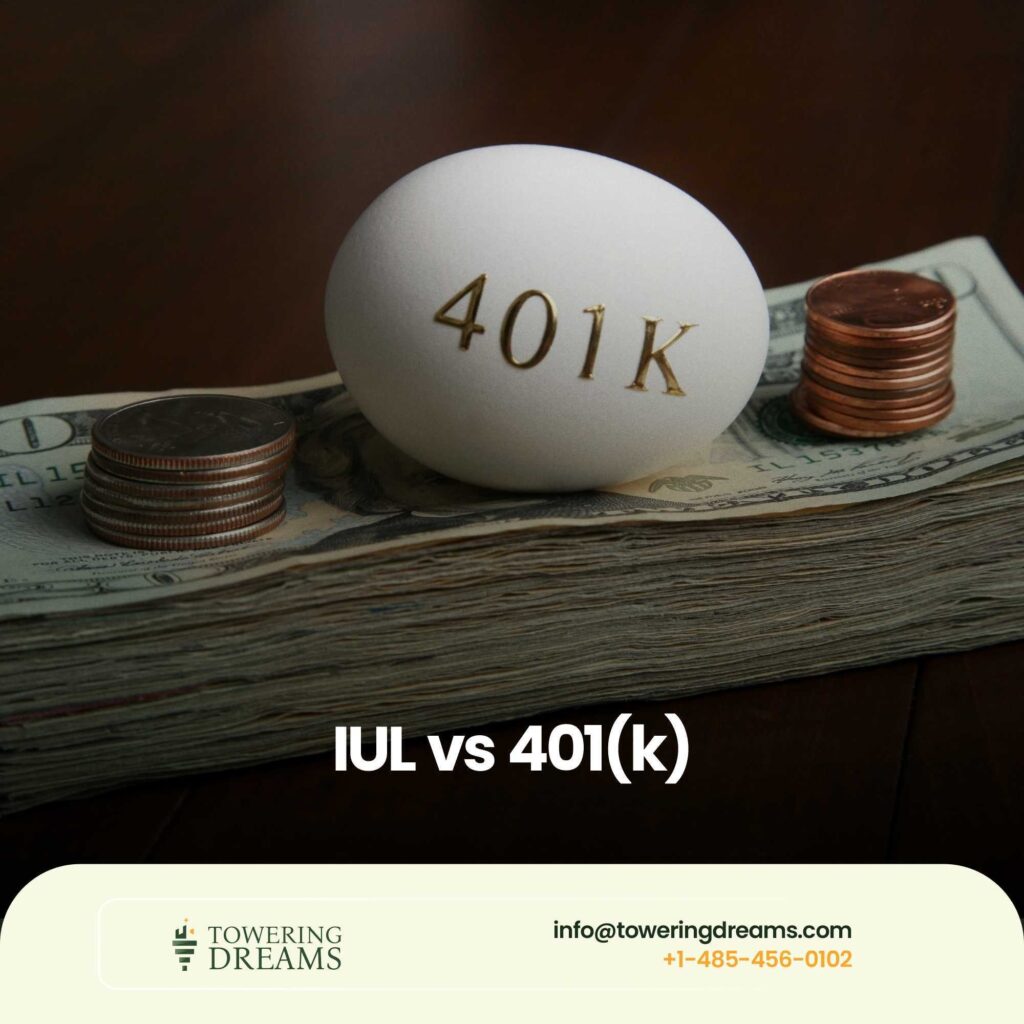
When it comes to building a secure retirement, few decisions carry more long-term financial weight than how you structure your savings. Two vehicles that are increasingly discussed in the same conversation are the 401(k) — the workplace retirement account that has become the cornerstone of American retirement planning — and Indexed Universal Life insurance, a permanent life insurance product with a tax-advantaged cash value component that can be used as a supplemental retirement income source.
These two products are built on fundamentally different frameworks, serve different primary purposes, and deliver their benefits through entirely different mechanisms. Comparing them directly — as if choosing one means rejecting the other — misses how most financial advisors actually position them: as complementary tools that serve distinct roles in a well-rounded retirement strategy. That said, understanding the strengths, limitations, and tax implications of each is essential for anyone trying to make informed decisions about their financial future. This article provides a clear, side-by-side comparison.
Summary
A 401(k) is an employer-sponsored, tax-deferred retirement savings account that allows pre-tax contributions, potential employer matching, and broad investment options including equities and bonds — but all distributions in retirement are taxed as ordinary income. An IUL is a permanent life insurance policy with index-linked cash value growth, a 0% floor that protects against market losses, and — when properly structured — tax-free access to cash value through policy loans. The 401(k) wins on simplicity, contribution limits, and employer match; the IUL wins on tax-free access, market downside protection, no required minimum distributions, and the added benefit of a death benefit. For most earners, the optimal strategy is to maximize the 401(k) first — especially if an employer match is available — and use IUL as a complementary tax-free income layer on top.
How a 401(k) Works

A 401(k) is a defined contribution retirement savings plan offered by employers that allows employees to contribute a portion of their pre-tax salary into an investment account. Contributions reduce the employee’s taxable income in the year they are made — a dollar contributed to a 401(k) is a dollar not taxed today. Inside the account, investments grow tax-deferred: dividends, capital gains, and interest accumulate without annual tax liability. The tax bill is deferred until withdrawals are made in retirement, at which point distributions are taxed as ordinary income.
For 2024, the IRS allows employees to contribute up to $23,000 annually to a 401(k), with a catch-up contribution of an additional $7,500 for those aged 50 and older. Many employers enhance this by matching a portion of employee contributions — a common structure being a 50% or 100% match up to a specified percentage of salary. This employer match is essentially free money, and it represents an immediate guaranteed return on the contributed dollar that no other financial product can replicate on its own.
The 401(k)’s investment options are typically a selection of mutual funds, index funds, target-date funds, and sometimes company stock. Market exposure is direct and unrestricted — gains can be substantial in strong markets, but losses are equally real in downturns. The 401(k) does not have a floor. A market decline of 30% produces a 30% loss in the account value, with no protective mechanism built into the structure. Withdrawals before age 59½ are subject to both ordinary income tax and a 10% early withdrawal penalty. Beginning at age 73, account holders must take Required Minimum Distributions (RMDs) annually, which can push retirees into higher tax brackets regardless of whether they need the income.
How an IUL Works as a Retirement Vehicle

An Indexed Universal Life policy is a permanent life insurance product that combines a death benefit with a cash value component. Premiums are paid with after-tax dollars — there is no upfront tax deduction. Inside the policy, the cash value earns credits based on the performance of a market index such as the S&P 500, subject to a floor — typically 0% — that prevents the cash value from declining in years when the index falls, and a cap or participation rate that limits the upside in strong years.
This structure means the IUL participates in market upside while being shielded from market downside. In a year the S&P 500 falls 20%, the policy credits 0% — no loss. In a year it rises 18% against a 10% cap, the policy credits 10%. The result is a smoother, more predictable accumulation curve than a direct market investment, at the cost of some upside in strong years. Over long periods, the elimination of significant loss years — and the compounding that results from never losing ground — can produce competitive net returns compared to direct market exposure that includes periodic sharp declines.
The defining tax advantage of a properly structured IUL is the ability to access accumulated cash value through policy loans that are not treated as taxable income by the IRS. When a policyholder borrows against the cash value, no income tax is triggered — regardless of the amount or how large the accumulated gains are. As long as the policy remains in force, these loans never have to be repaid, and the death benefit covers any outstanding loan balance at death. This mechanism creates a stream of tax-free retirement income that does not appear on a tax return, does not affect Social Security taxability, and does not count toward the income thresholds that determine Medicare premium surcharges.
Tax Treatment: The Core Difference

The most consequential difference between a 401(k) and an IUL — and the one that matters most in retirement — is how distributions are taxed. This is where the two products diverge most sharply.
A 401(k) operates on a tax-deferred basis. Every dollar contributed reduces taxable income today, and every dollar withdrawn in retirement is taxed as ordinary income at whatever rate applies at that time. This creates a significant future tax liability. For high earners who expect to remain in a high tax bracket in retirement — or who are concerned about future tax rate increases — the deferred tax bill may partially or entirely offset the upfront deduction benefit. Additionally, RMDs beginning at age 73 force withdrawals regardless of financial need, potentially pushing retirees into higher brackets and triggering higher Medicare premiums.
An IUL operates on a tax-free access model. Contributions are made with after-tax dollars — no deduction today — but qualified policy loans in retirement are not taxable income. There are no RMDs. The policy loans do not show up on a tax return. They do not inflate the income figure used to calculate Social Security taxation or Medicare Part B and D premiums. For a retiree trying to manage taxable income carefully, IUL policy loans are one of the only income sources that are genuinely invisible to the IRS. The death benefit, paid to beneficiaries at death, is also income-tax-free under IRC Section 101(a) — an advantage the 401(k) does not share, since inherited 401(k) balances are subject to income tax upon withdrawal by beneficiaries.
Contribution Limits, Flexibility, and Access

The 401(k) has defined, IRS-mandated contribution limits. In 2024, most employees can contribute up to $23,000 per year, rising with annual inflation adjustments. These limits are the same regardless of income level — a high earner contributing $23,000 faces the same ceiling as a lower earner. For individuals who want to save substantially more for retirement in a tax-advantaged structure, the 401(k) alone provides limited capacity.
An IUL has no IRS contribution limit tied to earned income. The amount that can be contributed is constrained only by the policy’s death benefit size and the Modified Endowment Contract rules under IRC Section 7702A — which set the maximum premium that can be paid in the first seven years before the policy loses its tax-free access benefits. For high earners who have maxed out their 401(k) and other qualified accounts, the IUL’s effectively unlimited premium capacity makes it one of the few remaining tax-advantaged vehicles available for additional retirement savings.
Access flexibility also differs significantly. A 401(k) locks contributions away until age 59½, with early withdrawals triggering both income tax and a 10% penalty. Hardship withdrawals are available under specific conditions but are taxable. An IUL allows access to cash value through policy loans or withdrawals at any time with no age restriction and no early withdrawal penalty — though managing loans carefully to avoid a taxable lapse event is essential. This liquidity advantage is meaningful for policyholders who may face financial needs before traditional retirement age.
Market Exposure, Risk, and Downside Protection

Risk tolerance and investment philosophy are central to how investors experience these two products differently. A 401(k) invested in equity-heavy mutual funds or index funds can deliver strong long-term returns — the S&P 500 has historically averaged approximately 10% annually before inflation — but it does so with full exposure to market volatility. In 2008, many 401(k) accounts lost 30% to 50% of their value. In 2022, balanced portfolios declined significantly. For investors nearing retirement, these downturns can be devastating because there is less time for the portfolio to recover before withdrawals begin.
The IUL’s 0% floor eliminates this category of risk entirely. In a market decline, the policy credits zero rather than a negative return. The cash value does not go backwards. This protection comes at a cost — the cap on upside means the IUL will underperform a direct equity investment in strong bull markets — but for conservative accumulators or those approaching retirement, the elimination of sequence-of-returns risk is a significant structural advantage. A retiree drawing income from an IUL does not face the scenario of withdrawing from a depleted account during a market downturn and permanently reducing their future balance.
The appropriate view is that the 401(k) and IUL manage risk differently rather than one being superior. The 401(k) offers higher potential returns in exchange for full market risk. The IUL offers protected, capped returns in exchange for predictability. A retiree with both has a natural hedge: when equity markets are strong, the 401(k) grows aggressively; when markets decline, the IUL continues crediting at the floor while the 401(k) is left undisturbed to recover. Withdrawing from the IUL during downturns and the 401(k) during up markets is a retirement income strategy that significantly reduces the impact of sequence-of-returns risk.
Employer Match: The 401(k)’s Unmatched Advantage

There is one area where the 401(k) holds an advantage over the IUL that cannot be replicated by any other financial product: the employer match. When an employer matches contributions — even at 50 cents on the dollar up to a specified limit — the employee receives an immediate 50% return on their contributed dollar before any investment gains occur. No life insurance product, no matter how efficiently designed, can manufacture an immediate guaranteed return of that magnitude.
This is why virtually every financial advisor, regardless of their views on IUL, recommends contributing to a 401(k) at least up to the employer match before directing additional dollars elsewhere. Leaving an employer match on the table in order to fund an IUL is almost never financially rational. The standard guidance is clear: capture the full employer match first, then evaluate additional retirement savings vehicles — including IUL — for the dollars beyond that threshold.
How IUL and 401(k) Work Best Together

The most financially sophisticated approach to retirement planning does not treat IUL and 401(k) as an either-or choice. They address different tax exposures, different risk profiles, and different income needs — making them genuinely complementary when used together.
A practical layered strategy looks like this: contribute to the 401(k) up to the full employer match to capture the guaranteed return. Consider maximizing the 401(k) if the tax deduction today is valuable — particularly for high earners in peak income years who expect to be in a lower bracket in retirement. Fund an IUL with after-tax dollars to build a tax-free income source that complements the taxable 401(k) distributions. In retirement, draw IUL policy loans during market downturns and during years when 401(k) distributions would push taxable income above critical thresholds for Social Security taxation, Medicare surcharges, or bracket management.
This two-bucket strategy — one taxable at distribution, one tax-free — gives retirees maximum flexibility to manage their annual taxable income, minimize lifetime taxes, and protect against both longevity risk and the sequence-of-returns risk that can derail even well-funded retirement plans. The 401(k) provides the scale and employer subsidy; the IUL provides the tax-free flexibility and downside protection. Together, they are stronger than either is alone.
You can always book a free strategy session with us. We will be glad to help you set up a policy and to help you make the most of it to achieve your aims and objectives.
Conclusion
The IUL versus 401(k) debate is less a competition than a case for strategic diversification. Each product was designed with a different purpose, a different tax structure, and a different risk profile. The 401(k) is a powerful, employer-subsidized vehicle for tax-deferred accumulation at scale. The IUL is a flexible, tax-free income tool with downside protection and no mandatory distribution requirements. Neither alone is the complete answer to retirement planning.
The investors who build the most tax-efficient, resilient retirement portfolios are not those who chose the “right” product — they are those who understood the strengths of both and deployed them deliberately. Capture the employer match, build the 401(k), and use the IUL to create the tax-free income layer that gives retirement planning its full range of options. That combination — more than any single product decision — is what financial security in retirement actually looks like.
Indexed Universal Life Insurance(IUL) policies also have a lot of features that can potentially provide a safety net for you and for your loved ones. You should check out this video on how to safeguard your future and that of your loved ones against unforseen circumstances like job loss or illnesses.
FAQ
Question 1: Should I choose an IUL or a 401(k) for retirement savings?
Answer: For most people, the answer is both — used together strategically rather than as alternatives. The 401(k) should be funded at least to the employer match, which provides an immediate guaranteed return no other product can match. Beyond the match, whether to prioritize additional 401(k) contributions or begin funding an IUL depends on your current tax bracket, expected retirement income needs, risk tolerance, and access to an independently designed IUL policy. A qualified financial advisor can model both scenarios using your specific numbers to determine the optimal allocation.
Question 2: Does IUL cash value count toward 401(k) contribution limits?
Answer: No. IUL premiums are entirely separate from 401(k) contributions and are governed by different IRS rules. The 401(k) has annual contribution limits set by the IRS — $23,000 in 2024 for most employees. IUL premiums have no IRS-imposed income-based contribution cap; they are constrained only by the policy’s death benefit size and the Modified Endowment Contract rules under IRC Section 7702A. Funding an IUL has no effect on your ability to contribute the maximum to your 401(k), and vice versa.
Question 3: What happens to a 401(k) and an IUL when I die?
Answer: When a 401(k) account holder dies, the remaining balance passes to named beneficiaries — but those beneficiaries must pay income tax on withdrawals from the inherited account. Under current law, most non-spouse beneficiaries must fully distribute the inherited 401(k) within 10 years of the account holder’s death, potentially creating significant taxable income. An IUL death benefit, by contrast, is paid directly to named beneficiaries income-tax-free under IRC Section 101(a), regardless of the amount. This difference makes the IUL significantly more efficient for wealth transfer purposes.
Question 4: Can I lose money in an IUL the way I can in a 401(k)?
Answer: Not from market performance. The IUL’s 0% floor means the cash value cannot decline due to index losses — in any year the index falls, the policy simply credits zero rather than a negative return. However, the policy’s internal charges — cost of insurance, administrative fees, and rider costs — are deducted from the cash value regardless of index performance. If the policy is severely underfunded, these charges can erode the cash value over time even in a flat index environment. The risk in an IUL is not market risk but policy management risk — ensuring the premium funding level is sufficient to sustain the policy over its intended life.
Question 5: Are Required Minimum Distributions a problem with IUL?
Answer: No. Required Minimum Distributions are a feature of qualified retirement accounts such as the 401(k), traditional IRA, and 403(b) — not of life insurance products. An IUL policy has no RMD requirement at any age. The policyholder controls when and how much they access through policy loans, with no IRS mandate to begin distributions at a specific age. This gives IUL policyholders significantly more control over their retirement income timing and their annual taxable income profile — a valuable advantage for retirees who want to avoid being forced into higher tax brackets by mandatory withdrawals they do not need.
At Towering Dreams we help American families to choose the right type of Indexed Universal Life ( IUL ) & Annuity plan.
One major takeaway for me is that different financial vehicles solve different problems. I’ve come to appreciate how a 401(k) can help build retirement assets efficiently, while an IUL can add tax diversification, liquidity, and a death benefit. This has made me think more strategically about creating multiple sources of retirement income rather than relying on a single solution.