
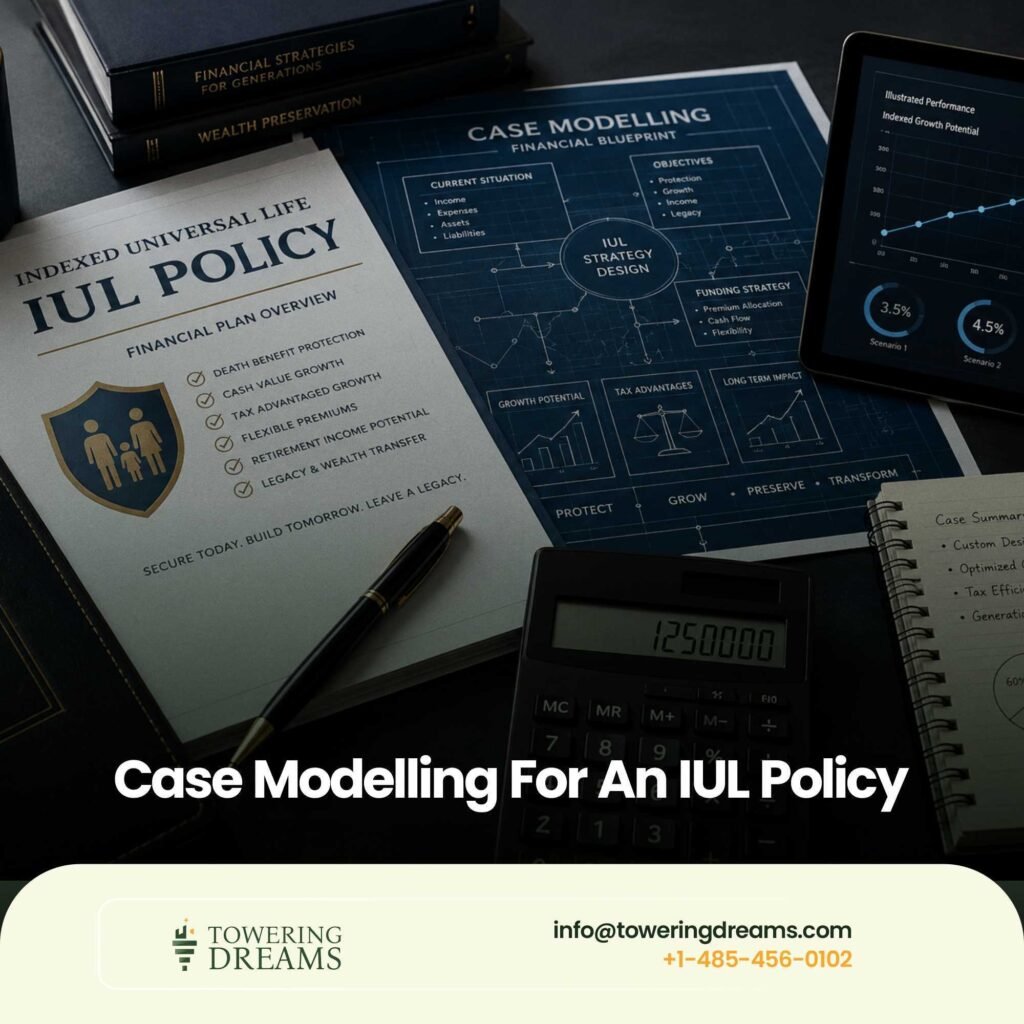
Buying an indexed universal life policy without running a proper case model is a bit like signing a mortgage without ever looking at an amortization schedule. The policy might be structured well, priced fairly, and issued by a reputable carrier, yet without a clear picture of how premiums, charges, and crediting assumptions interact over decades, it is nearly impossible to know whether the policy will actually do what it was purchased to do. Case modeling is the process that turns a general product concept into a specific, numbers-based projection tailored to one person’s goals and one policy’s design.
For agents, case modeling is a core part of the sales and planning process. For clients, understanding what a case model actually shows, and just as importantly what it does not show, is essential before relying on an illustration to make a major financial decision. IUL policies in particular involve enough moving parts, caps, floors, participation rates, cost of insurance charges, and policy loans among them, that a well-built case model is often the only way to see how those pieces actually behave together over the life of the policy.
This article explains what case modeling for an IUL policy involves, the key assumptions that drive the results, and how to read a case model with the right amount of skepticism and the right questions in mind.
Summary
Case modeling for an IUL policy is the process of building a detailed, year-by-year projection of a specific policy design, incorporating the client’s age, health class, premium schedule, death benefit option, and funding goals alongside the policy’s specific charges and crediting assumptions. Unlike a generic product brochure, a case model is customized to one person’s actual numbers and is meant to answer specific questions: How much premium is needed to sustain the policy to a certain age? What happens if index performance is below average for several years? How much can be taken out in retirement income without the policy lapsing?
Because IUL performance depends heavily on assumptions that cannot be known in advance, particularly future index crediting, a useful case model does not rely on a single optimistic scenario. It typically includes multiple illustrated rates, stress tests against poor sequences of returns, and a clear view of the guaranteed, non-guaranteed, and midpoint columns the illustration software produces. The sections below break down each component of the modeling process.
The Core Inputs That Shape a Case Model

Every case model in IUL begins with a set of client-specific inputs that will shape the entire projection. Age and health classification determine the cost of insurance charges applied throughout the policy’s life, and even a modest difference in underwriting class can meaningfully change how much of each premium dollar is available to build cash value versus cover insurance costs. Gender, in states where it remains a rating factor, and any rated or substandard classification also feed into these base costs.
The death benefit option selected, typically a level death benefit or an increasing death benefit that includes the accumulated cash value, changes both the cost of insurance over time and how efficiently cash value accumulates. A level death benefit generally keeps the net amount at risk, and therefore the insurance charges, lower in the earlier years, supporting faster cash value growth for policies designed primarily for accumulation and eventual income.
Premium amount and payment duration are equally central. A policy funded aggressively for a limited number of years behaves very differently than the same face amount funded with smaller premiums stretched over a longer period. Case modeling allows an agent to test several funding patterns side by side, showing how each affects cash value growth, the coverage sustainable long-term, and sensitivity to below-average performance in the early years, which matters more than later performance due to the compounding effect of time.
Illustrated Rates and Why a Single Number Is Not Enough

Every IUL illustration includes an assumed rate of return, sometimes called the illustrated or non-guaranteed rate, used to project how the indexed account will grow. This rate is not a guarantee and is typically capped by regulatory limits on how optimistic an illustration can be, but it still represents only one possible path among many. A model built around a single illustrated rate can create a misleading impression of smooth, consistent growth that real index performance is very unlikely to produce.
A more useful case model runs the same policy design at several different rates, commonly a guaranteed minimum scenario, a conservative non-guaranteed rate, and the maximum permitted illustrated rate, so the client can see the range of plausible outcomes rather than a single number presented as the expected result. Comparing how the death benefit, cash value, and any planned income withdrawals hold up across this range gives a far more honest picture of what the policy might actually deliver.
Some case models go further and incorporate historical index return sequences, applying the actual year-by-year performance of an index like the S&P 500 over a specific historical period, run through the policy’s cap and participation rate structure, to show how the policy would have performed had it existed during that stretch of market history. While past performance is never a guarantee of future results, this approach grounds the model in real volatility patterns rather than a smooth assumed average.
Stress Testing Against Poor Sequences of Returns

One of the most valuable things a good case model can do is show what happens to a policy under a genuinely unfavorable sequence of returns, not just a lower average return. Two policies can share the same average crediting rate over twenty years yet produce very different outcomes depending on when the weak years occur, particularly if premiums have stopped or loans are being taken during that stretch.
A thorough case model will typically run at least one scenario reflecting a run of low or zero-crediting years, especially positioned during the years when the client plans to begin taking loans or withdrawals for retirement income. This reveals whether the policy has enough of a buffer to absorb a bad stretch without requiring additional premium or risking a lapse. Policies that look strong under a flat, average assumption can sometimes reveal much thinner margins once a realistic bad-case sequence is applied, which is exactly the kind of insight a single-rate illustration cannot provide.
This kind of stress testing is particularly important for policies intended to fund retirement income through policy loans, since a policy that lapses with an outstanding loan can trigger a significant, often unexpected, taxable event. Modeling this risk in advance, rather than discovering it after decades of premium payments, is one of the primary reasons case modeling matters as much as it does.
Modeling Policy Loans and Withdrawal Strategies

For IUL policies designed to eventually provide supplemental retirement income, the loan or withdrawal phase deserves its own dedicated modeling, separate from the accumulation phase. A case model should show the specific loan type being illustrated, whether a fixed-rate loan or an indexed loan, since these behave very differently, and should reflect a realistic, sustainable withdrawal amount rather than an aggressive figure chosen simply to make the projected income number look larger.
It is worth modeling several withdrawal amounts and starting ages side by side to see how sensitive the policy is to these choices. A modest reduction in the planned income amount, or delaying the start of withdrawals by even a few years, can sometimes meaningfully improve a policy’s ability to sustain income for life without lapsing, and seeing that tradeoff clearly in a model is far more useful than a single optimistic income projection.
The model should also make clear what happens if income needs to be reduced or paused during a period of poor index performance, since a policy that requires rigid, unchangeable withdrawals regardless of market conditions carries more risk than one designed with some flexibility built into the plan from the start.
Reading a Case Model with the Right Questions in Mind

When reviewing a case model, it helps to look past the headline numbers on the illustrated, non-guaranteed column and ask a specific set of questions. What does the guaranteed column show, assuming minimum crediting and maximum charges for the life of the policy? At what age does the policy lapse under a stress-tested poor sequence of returns, and does that age fall before or after the client’s expected need for the coverage or income? How sensitive are the results to a modest change in premium amount, funding duration, or withdrawal timing?
It is also worth asking whether the illustrated cap, participation rate, and other crediting terms shown throughout the entire projection reflect current policy terms held constant, since insurers can and do adjust these terms over time. A model that holds today’s cap flat for forty years is showing a best-case assumption about future insurer behavior, not a guarantee, and understanding that distinction is important context for interpreting the numbers.
Finally, it is reasonable to ask for the model to be rerun periodically, particularly after several years have passed and actual policy performance can be compared against the original illustration. A policy that is underperforming its original projection may need adjusted premiums or expectations well before a problem becomes serious, and ongoing in-force illustrations serve the same purpose years into the policy that the original case model served at the point of sale.
You can always book a free strategy session with us. We will be glad to help you set up a policy and to help you make the most of it to achieve your aims and objectives.
Conclusion
Case modeling turns an IUL policy from a general concept into a specific, testable plan built around one person’s actual goals, health, and funding capacity. Because so much of a policy’s long-term performance depends on assumptions that cannot be known with certainty, a case model is only as useful as the range of scenarios it examines. A single illustrated rate presented as the expected outcome tells a much thinner story than a model that includes guaranteed, conservative, and stress-tested scenarios side by side.
Whether reviewing a case model as part of a new purchase or requesting an updated in-force illustration on an existing policy, asking pointed questions about guaranteed columns, stress-tested sequences, and the sustainability of any planned withdrawals turns the exercise from a sales tool into a genuinely useful planning instrument. A policy modeled thoroughly at the outset, and revisited periodically thereafter, gives both the client and the agent a far clearer path to making sure the policy performs the way it was actually intended to.
Indexed Universal Life Insurance(IUL) policies have a lot of features that can potentially provide a safety net for you and for your loved ones. You should check out this video on how to safeguard your future and that of your loved ones against unforseen circumstances like job loss or illnesses for more information.
FAQ
Question 1: What is the difference between a case model and a standard illustration?
Answer: A standard illustration typically shows a single policy design at one or two assumed rates. A case model is a more thorough process that customizes the design to a specific client’s numbers and often includes multiple rate scenarios, stress tests, and side-by-side comparisons of different funding or withdrawal strategies.
Question 2: Why does the guaranteed column in an illustration usually look so much worse than the non-guaranteed column?
Answer: The guaranteed column reflects the minimum crediting rate and maximum allowable charges the contract permits, essentially a worst-case scenario built into the policy’s guarantees. It is meant to show the floor of what could happen, not a likely outcome, and is a useful check against relying only on more optimistic projections.
Question 3: How often should a case model or illustration be updated after a policy is purchased?
Answer: Reviewing an in-force illustration every one to three years is a common practice, and more frequently if actual index performance has been notably strong or weak compared to the original assumptions. This helps catch underperformance early enough to adjust premiums or expectations before a lapse risk develops.
Question 4: Can a case model predict exactly how my policy will perform?
Answer: No case model can predict actual future index performance with certainty, since that depends on real market behavior over decades. What a good model can do is show a realistic range of outcomes and reveal how sensitive the policy is to different assumptions, which is different from making an exact prediction.
Question 5: Should I be concerned if different agents show me different case models for a similar policy?
Answer: Some variation is normal, since illustrated rates, funding patterns, and assumptions can differ between proposals. It is worth asking each agent to show the guaranteed column and a stress-tested scenario for direct comparison, rather than comparing only the most optimistic non-guaranteed projections against each other.

At Towering Dreams we help American families to choose the right type of Indexed Universal Life ( IUL ) & Annuity plan.
This article gave me a better understanding of why personalized policy modeling matters. I’ve learned that projecting the policy year by year can reveal potential challenges and opportunities that may not be obvious from a general illustration. It has encouraged me to look more closely at different scenarios before making long-term decisions about an IUL.