
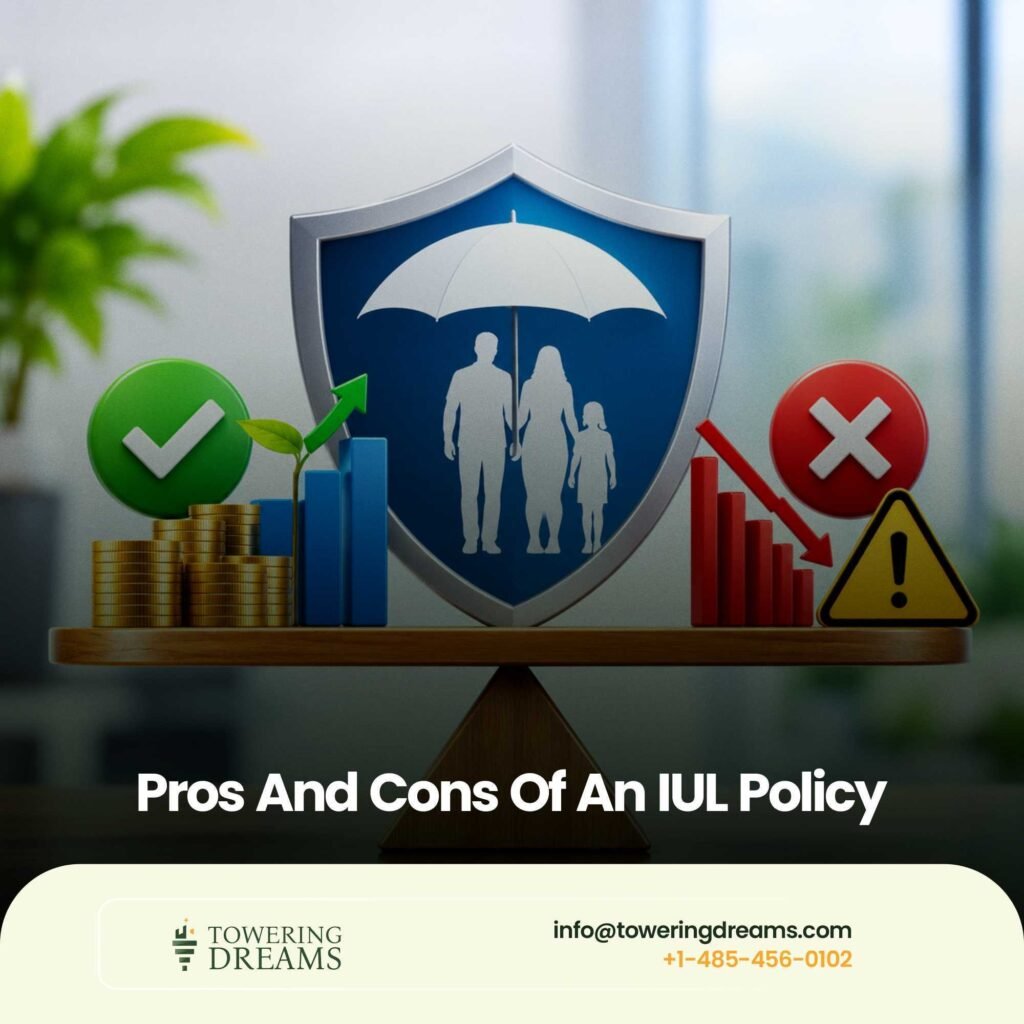
Indexed Universal Life (IUL) insurance is promoted as a way to get lifelong protection, tax-advantaged cash value growth and some shelter from market losses, all in one product. For some people, that combination is genuinely useful. For others, it turns out to be more expensive, more complicated and less predictable than they were led to expect.
The difference often comes down to understanding what an IUL can and cannot do. A policy that is well designed, properly funded and matched to a clear goal can perform well. A policy bought on the strength of an optimistic illustration can disappoint.
This article explains how an IUL works, then walks through its main advantages and disadvantages, and finishes with guidance on who may benefit and how to evaluate a policy before buying.
Summary
An IUL is a form of permanent life insurance that pays a death benefit for life as long as the policy stays in force, and builds cash value linked to the performance of a market index. The cash value is credited with interest based on the index, subject to a floor that protects against negative index returns and caps or participation rates that limit the upside.
The main advantages are lifelong coverage, flexible premiums and death benefits, tax-deferred growth, access to cash value through loans and withdrawals, and downside protection. The main disadvantages are higher cost than term insurance, complexity, non-guaranteed crediting terms, the risk of lapse if underfunded, and illustrations that can set unrealistic expectations. An IUL is not an investment in the stock market, and results depend heavily on how the policy is designed and managed.
How an IUL Policy Works

Each premium payment goes toward the cost of insurance, policy fees and the cash value account. The cost of insurance rises as the insured gets older, and it is deducted from the policy’s value each month. Whatever is left in the cash value account is available to earn interest.
The interest credited is based on the movement of a chosen index, such as the S&P 500, over a set period. The policy owner does not own the index or invest directly in it. Instead, the insurer uses the index as a reference to calculate credited interest. If the index rises, a portion of the gain is credited, limited by a cap, participation rate or spread. If the index falls, the credited rate is typically floored at zero.
Because the policy is universal life, the owner can usually adjust the premium within limits and may be able to change the death benefit. This flexibility is one of its strengths and also one of its risks, since insufficient funding can cause the policy to lapse.
Most policies also allow the owner to choose between increasing and level death benefit options. A level option keeps the death benefit constant, while an increasing option adds the cash value to the death benefit, at a higher cost of insurance. Understanding these choices at the start helps the policy match its intended purpose.
Pro: Lifelong Protection and Flexibility

A properly funded IUL provides permanent coverage. Unlike term insurance, which expires after a set period, an IUL can stay in force for life, so the death benefit is available whenever the insured passes away. This is valuable for needs that do not go away, such as estate liquidity, legacy planning or providing for a dependent with lifelong needs.
The flexibility of the product is another benefit. Owners can often increase or decrease premiums, depending on their cash flow and the policy’s funding level, and many policies allow adjustments to the death benefit. This can help when income fluctuates, as it does for self-employed people and business owners.
Many IULs also offer optional riders. Living benefit riders, for example, may allow access to part of the death benefit if the insured is diagnosed with a qualifying chronic or terminal illness. These add practical value, though they may carry additional cost or conditions.
Pro: Downside Protection and Growth Potential

The floor is the most-cited advantage. When the index declines, the policy is generally credited a minimum rate, often zero, so the cash value does not lose ground because of the market’s performance. Fees and insurance charges are still deducted, but the credited rate itself does not turn negative. For people who are wary of market swings, this can make the product appealing.
At the same time, the policy offers the potential to earn more than a traditional fixed account in years when the index performs well. Over long periods, a combination of the floor and capped upside can produce a smoother pattern of credited returns than direct stock market exposure.
Some policies also offer multiple index options and crediting methods, so the owner can diversify across strategies. Others include fixed account options for more predictable credits. This variety allows the policy to be tailored, although it also adds to the complexity of managing it.
Pro: Tax Advantages and Access to Cash

Under current U.S. tax law, the cash value in a life insurance policy generally grows tax-deferred, meaning that gains are not taxed each year as they accumulate. The death benefit is also generally paid to beneficiaries free of federal income tax. These features can make an IUL a useful complement to other savings vehicles, especially for people who have already maximized retirement account contributions.
Owners can access cash value through withdrawals or policy loans. Withdrawals up to the amount of premiums paid, known as basis, are generally not taxed. Loans are generally not treated as taxable income as long as the policy remains in force and is not classified as a modified endowment contract. This can provide a source of funds for emergencies, business opportunities or supplemental retirement income.
The tax treatment depends on the policy being structured and maintained properly. If a policy lapses with an outstanding loan, the loan balance above basis can become taxable. Anyone planning to rely on this feature should consult a qualified tax professional.
Con: Cost, Complexity and Fees

IUL policies are usually considerably more expensive than term insurance for the same death benefit. Premiums must cover the cost of insurance, administrative charges, expense charges and rider costs, and these deductions reduce the cash value available to grow. In the early years, high charges and sometimes surrender charges can mean that cash value is low.
The product is also complex. Caps, participation rates, spreads, crediting methods and indices all affect how much interest is credited, and they interact in ways that are difficult for non-specialists to evaluate. Different carriers use different terms, so comparing two policies is not straightforward.
Importantly, crediting rates are usually not guaranteed beyond the stated minimums. Carriers can adjust caps and participation rates over time, within the limits in the contract, which means that the terms illustrated at the time of purchase may not remain in effect. Buyers who focus only on the headline growth potential can overlook these limits.
Con: Performance Risk, Lapse Risk and Misleading Illustrations

Because of caps and other limits, an IUL policy will usually not capture the full return of the underlying index. Dividends are generally not included, and in years of strong market performance the credited rate may be well below the index’s gain. Over long periods, the result may fall short of what a direct investment could have produced.
Underfunding is another risk. If premiums are too low, or if credited returns are lower than assumed, the cash value may not be enough to cover rising insurance costs in later years. The policy can then lapse, leaving the owner without coverage and possibly facing taxes on prior loans. Heavy policy loans can accelerate this problem, since loan interest accrues and reduces the available value.
Illustrations deserve particular caution. They show projections based on assumptions, and some use optimistic rates or aggressive index strategies that may not reflect likely results. Requesting a conservative illustration and reviewing the guaranteed column can provide a more realistic picture. Overfunding can also push a policy into modified endowment contract status, which changes the tax treatment of loans and withdrawals.
Who May Benefit and How to Evaluate a Policy

An IUL may suit people who need permanent coverage, have the means to fund the policy consistently and understand its limitations. Higher-income individuals who have already used other tax-advantaged accounts, business owners with specific planning needs and those with estate planning goals are among the groups that sometimes find it useful.
It is usually a poor fit for those who only need temporary coverage, who are on a tight budget or who expect to access large amounts of cash in the early years. In those cases, term insurance, perhaps combined with separate investing, may offer a more efficient solution.
Before buying, ask how the policy would perform under conservative assumptions, what the guaranteed values are, how long surrender charges apply, which terms the insurer may change and what happens if premiums are reduced. Compare more than one carrier, and work with a licensed professional who explains the downsides as clearly as the benefits.
It is also wise to plan for the long term. An IUL is not a short-term product, and it generally takes many years for cash value to build meaningfully. Scheduling an annual review with the insurer or advisor, checking that the policy remains on track, and adjusting premiums or allocations when needed can reduce the chance of unpleasant surprises in later years.
You can always book a free strategy session with us. We will be glad to help you set up a policy and to help you make the most of it to achieve your aims and objectives.
Conclusion
An IUL can offer lifelong protection, flexibility, tax advantages and a measure of protection from market declines. It can also be costly, complex and dependent on non-guaranteed assumptions, with real risks if it is underfunded or poorly understood.
The key is to treat it as an insurance product first and a savings feature second. If you need permanent coverage, can fund it consistently and review it regularly, an IUL may deserve a place in your plan. If not, simpler alternatives are often more appropriate. Careful comparison and realistic expectations are the best protection.
Indexed Universal Life Insurance(IUL) policies have a lot of features that can potentially provide a safety net for you and for your loved ones. You should check out this video on how to safeguard your future and that of your loved ones against unforseen circumstances like job loss or illnesses for more information.
FAQ
Question 1: Is an IUL the same as investing in the stock market?
Answer: No. The cash value is not invested in the market or in the index. The insurer uses the index’s performance to calculate credited interest, subject to a floor, caps, participation rates or spreads, so the policy owner does not directly gain or lose with the market.
Question 2: Can I lose money in an IUL policy?
Answer: The credited interest rate is typically floored at zero, so index declines do not reduce the cash value directly. However, insurance charges and fees are still deducted, so the cash value can decrease, especially in the early years or if the policy is underfunded.
Question 3: Are IUL loans really tax-free?
Answer: Policy loans are generally not taxable while the policy remains in force and is not a modified endowment contract. If the policy lapses or is surrendered with an outstanding loan, the amount above your basis may become taxable, so it is important to manage loans carefully.
Question 4: Is an IUL better than term life insurance?
Answer: It depends on your needs. Term is usually cheaper and ideal for temporary needs such as a mortgage or raising children. An IUL is permanent coverage that costs more and may suit lifelong needs such as estate planning, but it is more complex.
Question 5: Are the caps and participation rates guaranteed?
Answer: Usually not beyond the minimums stated in the contract. Insurers can change caps, participation rates and spreads over time, so the terms shown in an illustration at purchase may not remain the same in the future.

At Towering Dreams we help American families to choose the right type of Indexed Universal Life ( IUL ) & Annuity plan.