
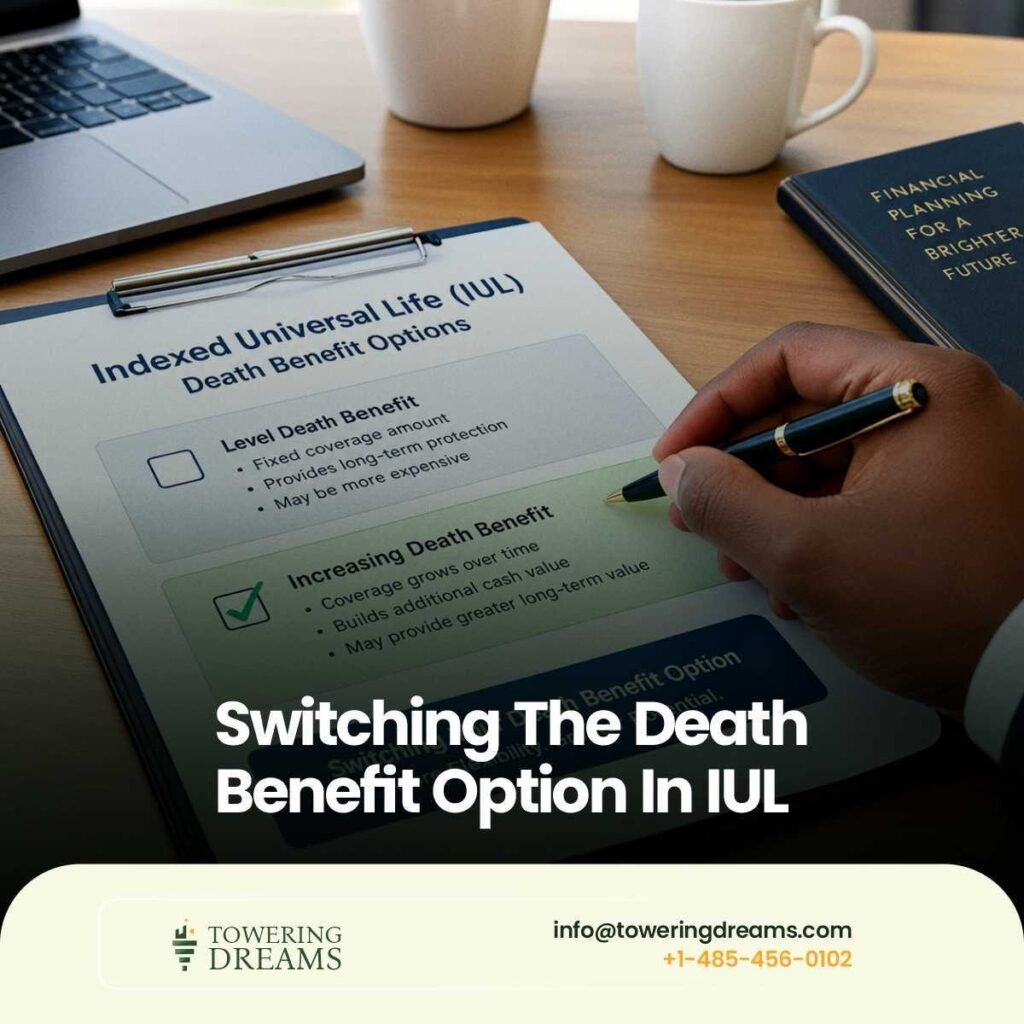
One of the lesser-known features of an indexed universal life policy is the ability to choose, and later switch, between different death benefit structures without necessarily starting a brand new policy from scratch. This flexibility is built directly into the design of most IUL contracts, and it exists precisely because the right death benefit structure at age 35, when someone is focused on income replacement and family protection, is often not the right structure at age 55, when the same person may be more focused on cost efficiency and cash value growth.
Understanding how death benefit options work, what actually changes when a policyholder switches between them, and what the practical tradeoffs look like is important for anyone managing an existing IUL policy over the long term. A switch made at the right time, for the right reason, can meaningfully improve how efficiently a policy performs, while a switch made without understanding its full implications can create unexpected tax consequences or undermine a policy’s long-term cost structure.
This article explains the two primary death benefit options available in most IUL policies, how switching between them actually works, why a policyholder might want to make this change, and the specific considerations worth reviewing before doing so.
Summary
Most IUL policies offer at least two death benefit options: a level death benefit, where the payout remains a fixed amount regardless of how much cash value the policy has accumulated, and an increasing death benefit, where the payout equals a stated base amount plus the current cash value. Many policies allow policyholders to switch between these options after the policy has already been issued, sometimes without requiring new underwriting, depending on the specific direction of the change being made.
Switching from an increasing death benefit to a level death benefit generally reduces the insurer’s future payout obligation and typically does not require new underwriting, while switching from level to increasing effectively increases future exposure for the insurer and often requires the same underwriting scrutiny as a straightforward death benefit increase. Understanding these mechanics, along with how each option affects the ongoing cost of insurance and cash value growth, helps policyholders decide whether and when switching makes sense for their specific situation.
Understanding the Two Main Death Benefit Options

A level death benefit, sometimes called Option A or Option 1 depending on the insurer, pays a fixed, stated death benefit amount regardless of how much cash value the policy has accumulated at the time of death. If a policy has a one million dollar level death benefit and one hundred thousand dollars of accumulated cash value, the beneficiary still receives one million dollars total, not the death benefit plus the cash value on top of it.
An increasing death benefit, sometimes called Option B or Option 2, pays a stated base death benefit plus whatever cash value the policy has accumulated at the time of death. Using the same example, an IUL policy with a one million dollar base death benefit under this option and one hundred thousand dollars of cash value would pay out one million one hundred thousand dollars total, since the cash value is added on top of the base amount rather than being absorbed into it.
This structural difference has a direct effect on what insurers refer to as the net amount at risk, meaning the actual amount of pure insurance coverage the insurer is providing beyond the policy’s own cash value. Under a level death benefit, the net amount at risk shrinks as cash value grows, since the insurer’s exposure decreases the more cash value effectively covers the stated death benefit. Under an increasing death benefit, the net amount at risk remains constant regardless of cash value growth, since the insurer always owes the full base amount on top of whatever cash value exists.
How Cost of Insurance Differs Between the Two Options

Because cost of insurance charges are calculated based on the net amount at risk rather than the total death benefit, a level death benefit generally becomes progressively less expensive to maintain as cash value grows, since the shrinking net amount at risk directly reduces the insurance charges deducted each period. This makes a level death benefit generally more cost-efficient over time for a policy focused primarily on cash value accumulation and eventual retirement income.
An increasing death benefit, by contrast, maintains a constant net amount at risk throughout the policy’s life, meaning cost of insurance charges do not benefit from the same natural reduction as cash value accumulates. This makes an increasing death benefit generally more expensive to maintain over the long run, though it does provide a death benefit that keeps pace with the policy’s cash value, which some policyholders value for estate planning purposes.
This cost difference is a central reason many policyholders choose an increasing death benefit in a policy’s early years, when the difference in absolute dollar terms is relatively small, and then switch to a level death benefit later once cash value has grown substantially and the cost efficiency of the level option becomes more meaningful.
The Mechanics of Switching Between Options

Switching from an increasing death benefit to a level death benefit is generally treated similarly to a death benefit decrease from the insurer’s perspective, since it reduces the ultimate payout obligation the insurer is exposed to. This direction of change typically does not require new underwriting, since a reduction in the insurer’s risk does not raise the same concerns as an increase in coverage.
Switching from a level death benefit to an increasing death benefit works in the opposite direction, effectively increasing the insurer’s future payout exposure, and this typically does require new underwriting similar to what would be involved in a straightforward death benefit increase, including updated health questions and, depending on the size of the change, potentially a new medical exam.
The actual process of requesting a switch is usually straightforward administratively, typically a simple form submitted to the insurer, though underwriting requirements, when applicable, can take additional time. It is worth requesting an updated illustration showing how the switch would affect the policy’s projected performance before finalizing the change, since seeing the specific numbers helps confirm it will actually achieve the intended goal.
Why a Policyholder Might Want to Switch

The most common reason to switch from an increasing to a level death benefit is to reduce ongoing cost of insurance charges once substantial cash value has accumulated, freeing up more of each premium dollar, or more of the policy’s existing cash value, to continue growing rather than being consumed by insurance costs that no longer need to be as high given the accumulated cash value cushion already in place.
This switch is particularly common as a policyholder approaches the point where they plan to begin taking withdrawals or loans for retirement income, since reducing ongoing insurance costs at this stage helps preserve more of the policy’s cash value for the income phase, extending how long the policy can sustainably support planned withdrawals before running into funding problems.
Less commonly, a policyholder might switch from a level to an increasing death benefit if their coverage needs have grown, such as after a significant increase in income or estate planning needs, and they want the death benefit to keep pace with rising cash value rather than staying fixed. Since this direction requires new underwriting, it generally only makes sense when the policyholder is confident they remain in good enough health to qualify.
Tax and Structural Considerations Before Switching

A significant change to a policy’s death benefit structure can, in certain circumstances, affect the policy’s status under IRS rules governing modified endowment contracts, since the relationship between premiums paid and death benefit provided factors directly into that classification. This is more likely with a death benefit decrease than an increase, since reducing the death benefit while cash value remains the same effectively increases the ratio of premium funding relative to the smaller death benefit, which can, in some cases, push a policy over its seven-pay limit.
Confirming with the insurer how a proposed switch would affect the policy’s modified endowment contract status, if relevant, is a reasonable step before finalizing any significant death benefit change, particularly for a policy funded aggressively relative to its original death benefit. This is a detail that is easy to overlook, since the switch itself feels like a simple administrative request rather than something with tax implications.
It is also worth considering how a switch affects future flexibility. A policyholder who switches to a level death benefit and later decides to switch back to an increasing death benefit would need to go through new underwriting at that point, based on their health at that future time rather than at the original purchase, meaning the decision to switch is not entirely without consequence if circumstances change again later.
Reviewing the Decision With an Updated Illustration

Before finalizing a death benefit switch, requesting an updated illustration that models the policy’s projected performance under both the current structure and the proposed new structure provides the clearest picture of how the change would actually affect long-term outcomes. This comparison should ideally include projected cash value growth, projected cost of insurance charges over time, and how the change might affect sustainability if withdrawals or loans are planned in the future.
For a policyholder planning a switch specifically to improve cost efficiency ahead of a retirement income phase, it can also be worth requesting a stress-tested version of the illustration, modeling how the policy performs under an unfavorable sequence of index returns both with and without the proposed switch. This gives a more realistic sense of whether the switch meaningfully improves the policy’s margin of safety, rather than relying solely on a smooth, averaged illustration.
Working through this comparison with the issuing insurer or a financial professional familiar with the policy’s history and design ensures the switch is made with a clear understanding of its actual effect, rather than a general assumption that a level death benefit is always more efficient, which, while often true, depends on the specific numbers involved in each policy.
You can always book a free strategy session with us. We will be glad to help you set up a policy and to help you make the most of it to achieve your aims and objectives.
Conclusion
Switching between a level and an increasing death benefit is one of the more flexible features available within many IUL policies, allowing a policyholder to adjust a policy’s cost structure and coverage design as their needs and priorities change over the life of the contract. Switching to a level death benefit generally reduces ongoing costs and typically does not require new underwriting, while switching to an increasing death benefit expands future coverage but generally requires the same underwriting scrutiny as a straightforward death benefit increase.
Reviewing an updated illustration, and confirming how a proposed switch might affect a policy’s modified endowment contract status, gives a policyholder the information needed to make this decision with confidence rather than assuming any particular option is universally the right choice. For many policyholders, the right structure genuinely does change over time, and the built-in flexibility to switch between options is one of the more practically useful features an IUL policy has to offer.
Indexed Universal Life Insurance(IUL) policies have a lot of features that can potentially provide a safety net for you and for your loved ones. You should check out this video on how to safeguard your future and that of your loved ones against unforseen circumstances like job loss or illnesses for more information.
FAQ
Question 1: Do I need a medical exam to switch from an increasing to a level death benefit?
Answer: Generally no. Switching from an increasing death benefit to a level death benefit reduces the insurer’s future payout obligation, so this direction of change typically does not require new underwriting or a medical exam.
Question 2: Why would someone choose a level death benefit over an increasing one?
Answer: A level death benefit generally results in lower ongoing cost of insurance charges as cash value grows, since the net amount at risk shrinks over time. This makes it a more cost-efficient choice for policyholders focused primarily on cash value accumulation and eventual retirement income.
Question 3: Can switching my death benefit option affect my policy’s tax status?
Answer: It can, in certain circumstances, particularly with a death benefit decrease, since this can affect the ratio between premiums paid and death benefit provided that determines modified endowment contract status. Confirming this with your insurer before finalizing a significant switch is a reasonable precaution.
Question 4: Is it common to start with an increasing death benefit and later switch to level?
Answer: Yes, this is a fairly common strategy. Starting with an increasing death benefit allows the total payout to grow alongside cash value in the earlier years, and switching to a level death benefit later, once substantial cash value has accumulated, improves cost efficiency heading into a policy’s later years or a planned income phase.
Question 5: Should I request anything specific before deciding to switch my death benefit option?
Answer: Requesting an updated illustration comparing the policy’s projected performance under both the current and proposed death benefit structures is strongly recommended. This gives a concrete, numbers-based basis for the decision rather than relying on a general assumption about which option is more efficient.

At Towering Dreams we help American families to choose the right type of Indexed Universal Life ( IUL ) & Annuity plan.